What Your Body Believes
I have been reading James K. A. Smith’s book "Imagining the Kingdom: How Worship Works" for a seminary course, and somewhere in the second chapter, I felt I had to share it.
We are not as thoughtful as we think
Most of us assume that we do what we do because of what we believe. We hear a truth, we think it over, we decide, and then we act. Smith calls this the “intellectualist” picture of the human being, and he says it is simply wrong. “What if we are actors before we are thinkers?” he asks. “What if action is driven less by what we think and more by what we love?” Long before we reason about anything, we have already been given a feel for the world, “a kind of ‘feel’ for the world that disposes us” to see it one way rather than another. Most of what we do flows from that feel, not from a decision.
Where does the feel come from? Here Smith turns to the sociologist Pierre Bourdieu, and this is where the book began to read like a mirror. Bourdieu spent years watching how ordinary communities pass on their way of life, and he discovered that they do it mostly through things too small to notice. His words are worth reading twice: a whole “cosmology” can be instilled “through injunctions as insignificant as ‘sit up straight’ or ‘don’t hold your knife in your left hand,’” which inscribe “the most fundamental principles” of a culture “in seemingly innocuous details of bearing or physical and verbal manners, so putting them beyond the reach of consciousness and explicit statement.”
Read that slowly. A child learning to hold her fork is being taught how to see the world, and nobody told her so. Bourdieu calls this “the cunning of pedagogic reason”: it “manages to extort what is essential while seeming to demand the insignificant.” The habits go so deep that they stop feeling like habits. They become, in his phrase, “embodied history, internalized as a second nature and so forgotten as history.” They feel like just the way things are.
And here is the sentence that undid me. Bourdieu says that this kind of belief “is not a ‘state of mind’… but rather a state of the body.” Smith adds that it is not only our small beliefs that live in the body while the big ones stay in the mind. Our “ultimate beliefs, our defining beliefs, our ‘most precious values’” are carried there too. “Ritual,” he concludes, “is the way we (learn to) believe with our bodies.”
The Bible knew this first
When I read that, I did not think of philosophy. I thought of Deuteronomy.
Moses, on the edge of the Promised Land, tells Israel how to keep the faith alive across generations. Notice that he does not hand them a curriculum. He hands them a way of life. “These words that I command you today shall be on your heart. You shall teach them diligently to your children, and shall talk of them when you sit in your house, and when you walk by the way, and when you lie down, and when you rise. You shall bind them as a sign on your hand, and they shall be as frontlets between your eyes. You shall write them on the doorposts of your house and on your gates” (Deuteronomy 6:6–9).
Look at where the Word is supposed to go. On the heart, yes, but then on the hand, before the eyes, on the doorpost, on the gate. Sitting, walking, lying down, rising. Moses is describing a faith that is absorbed through the rhythms of a household until a child cannot remember not knowing it. He understood that a people is formed by what it does every day at the door, not only by what it hears once a week at the sanctuary. Bourdieu would call that a habitus. Moses simply called it the way you love the Lord your God with all your heart, soul, and might.
Paul saw the same thing from the other side. In Romans 12:1–2 he writes, “Present your bodies as a living sacrifice, holy and acceptable to God, which is your spiritual worship. Do not be conformed to this world, but be transformed by the renewal of your mind.” We usually rush to the second verse because we like the part about the mind. But Paul starts with the body, and the order is not accidental. The word he uses for “conformed” describes being pressed into a mold from outside; the word for “transformed” is the one used of Jesus on the mount of transfiguration, a change from within. Paul is warning that the world is shaping us through its molds, and Smith names them well: the mall, the stadium, the screen, the flag, each with “its own little rituals,” each quietly training our loves. Against that pressure Paul does not say, “Think harder.” He says, “Bring your body.” Worship, in Paul’s grammar, is what you do with your body, and the renewed mind grows out of the offered body, not the other way around.
Where the church undoes its own sermons
This is where the book stopped being interesting and started being convicting.
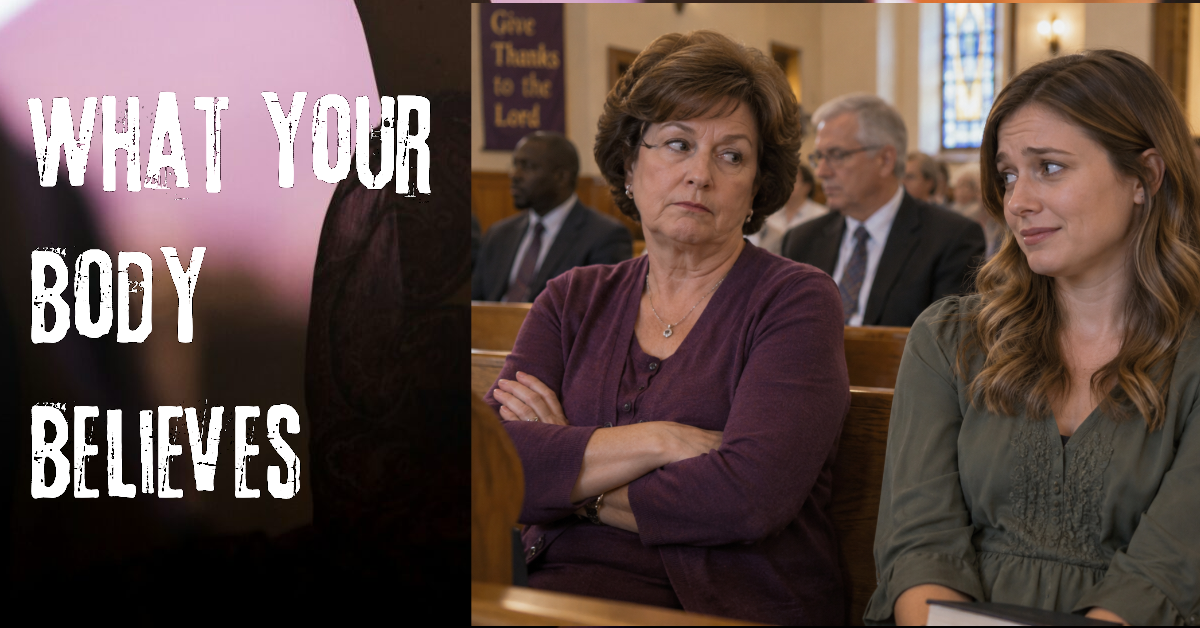
I have visited churches across this country for years, and I have noticed a pattern. We preach grace and practice inspection. We say from the pulpit that all are welcome, and then the body of the congregation, its glances, its seating, its silence toward the stranger, its unwritten rules about dress and who may stand where, says something else. And Smith has helped me understand why the second message wins. It wins because “our bodies are students even when we don’t realize it,” and because “this incarnate education ends up being the more powerful.” A sermon reaches the mind for thirty minutes. The way people are treated at the door reaches the body every week for a lifetime.
Jesus knew this. When the disciples pushed the children away, he did not deliver a lecture on the value of children. “He took them in his arms and blessed them, laying his hands on them” (Mark 10:16). The disciples had the right doctrine and the wrong bodies. Jesus corrected the bodies. And on the road to Emmaus, two disciples heard the finest Bible study ever given, from the risen Lord himself, and still did not recognize him. Their hearts burned, but their eyes stayed closed until “he took the bread and blessed and broke it and gave it to them” (Luke 24:30–31). The Word prepared them; the meal opened them. Smith ends his chapter with a story about an old man who learned to love by starting small, “a tree, a rock, a cloud,” and then adds the line I keep coming back to: “The God who is Love meets us in our banalities and teaches us to love from our end. Word. Wine. Bread.”
A call to a different kind of examination
Here is what I am asking of myself, and I invite you to ask it too.
First, examine your own habits, not just your beliefs. Ask what your body has been taught that your mind never approved. Where do you reach for your phone before you reach for prayer? What does your posture in worship say that your lips would never say? The Psalmist prayed, “Search me, O God, and know my heart” (Psalm 139:23), and the God who searches the heart also sees the hands.
Second, if you lead in any way, in a home, a Sabbath School class, a praise team, a greeting ministry, take responsibility for what the bodies under your care are learning. Paul told the Philippians, “What you have learned and received and heard and seen in me, practice these things” (Philippians 4:9). Heard and seen. Practice. Your people are not only listening to you; they are being trained by you.
Third, stop apologizing for repetition. The same songs, the same prayers, the same bread and cup, the same welcome at the same door: these are not signs of a church that has run out of ideas. They are how the kingdom gets written into people until it becomes second nature.
And finally, offer your body. Not your opinions, not your agreement, your body. Come to worship expecting God to do something in you that you cannot argue yourself into. Smith says that the Spirit “condescends to meet us as narrative, imaginative, ritual animals, giving us practices and liturgies for our sanctification.” That is grace at the level of the hands and knees. Present yourself as a living sacrifice, and let the God who formed you from the dust form you again.
Because in the end the question is not only what we say we believe. It is what our bodies believe. And the world, and the visitor in the back row, can tell the difference.
Written by Desert Witness
--------------------------------------------------------
Quotations are from James K. A. Smith, Imagining the Kingdom: How Worship Works (Grand Rapids: Baker Academic, 2013), chapters 1 and 2, and from Pierre Bourdieu, The Logic of Practice, as cited by Smith. Scripture quotations are from the English Standard Version.


